


Knowing how to find transformer rating is essential for every electrical engineer and procurement manager specifying power distribution equipment, Per IEEE C57.12.00, transformer ratings define the continuous operating limits – kVA, voltage, current, and frequency – that the unit can sustain without exceeding temperature rise limits or reducing service life.
What Is Transformer Rating?
Understanding how to find transformer rating starts with knowing what the rating means, A transformer rating is the complete set of electrical parameters printed on the nameplate – defining exactly how how is transformer rated for continuous service under specified ambient conditions.
Key parameters on a transformer nameplate
Every transformer nameplate contains the following rated parameters:
- kVA rating: Apparent power capacity – the maximum continuous load the transformer can carry at rated voltage and frequency without exceeding temperature rise limits
- Primary voltage: Input voltage rating – may include multiple tap positions (±2.5%, ±5%) for voltage adjustment
- Secondary voltage: Output voltage at full rated load – the voltage delivered to the load at 100% kVA
- Frequency: 50 Hz or 60 Hz – operating at incorrect frequency increases core losses and reduces efficiency
- Impedance (%Z): Typically 4–6% for distribution transformers – determines short-circuit current and voltage regulation
- Temperature rise: Maximum winding temperature rise above ambient (55°C or 65°C for oil-filled; 80°C–150°C for dry-type)
Read More : Protection of Transformer in Power System :A Complete
Importance transformer rating
Knowing how to find transformer rating correctly is not just a technical exercise – it directly determines system safety, efficiency, and service life:
- Undersizing causes overheating: Per IEEE C57.91, transformer insulation life halves for every 10°C above rated temperature – a consistently overloaded transformer degrades years faster than designed
- Oversizing wastes capital and reduces efficiency: Transformers operating below 30% of rated load suffer poor efficiency due to fixed core losses that run continuously regardless of load
- Incorrect voltage rating causes insulation failure: Operating above rated voltage increases core flux density, causing saturation, overheating, and accelerated insulation degradation
- Wrong impedance affects fault current: Low %Z transformers produce higher short-circuit currents – downstream switchgear and cables must be rated to withstand the available fault level
Find our Products : SCB14-NX2 Secondary dry-type transformer
How to find transformer rating?
There are three reliable methods for how to find transformer rating and how to how to find current rating of transformer in any installation:
Method 1 – Read the nameplate
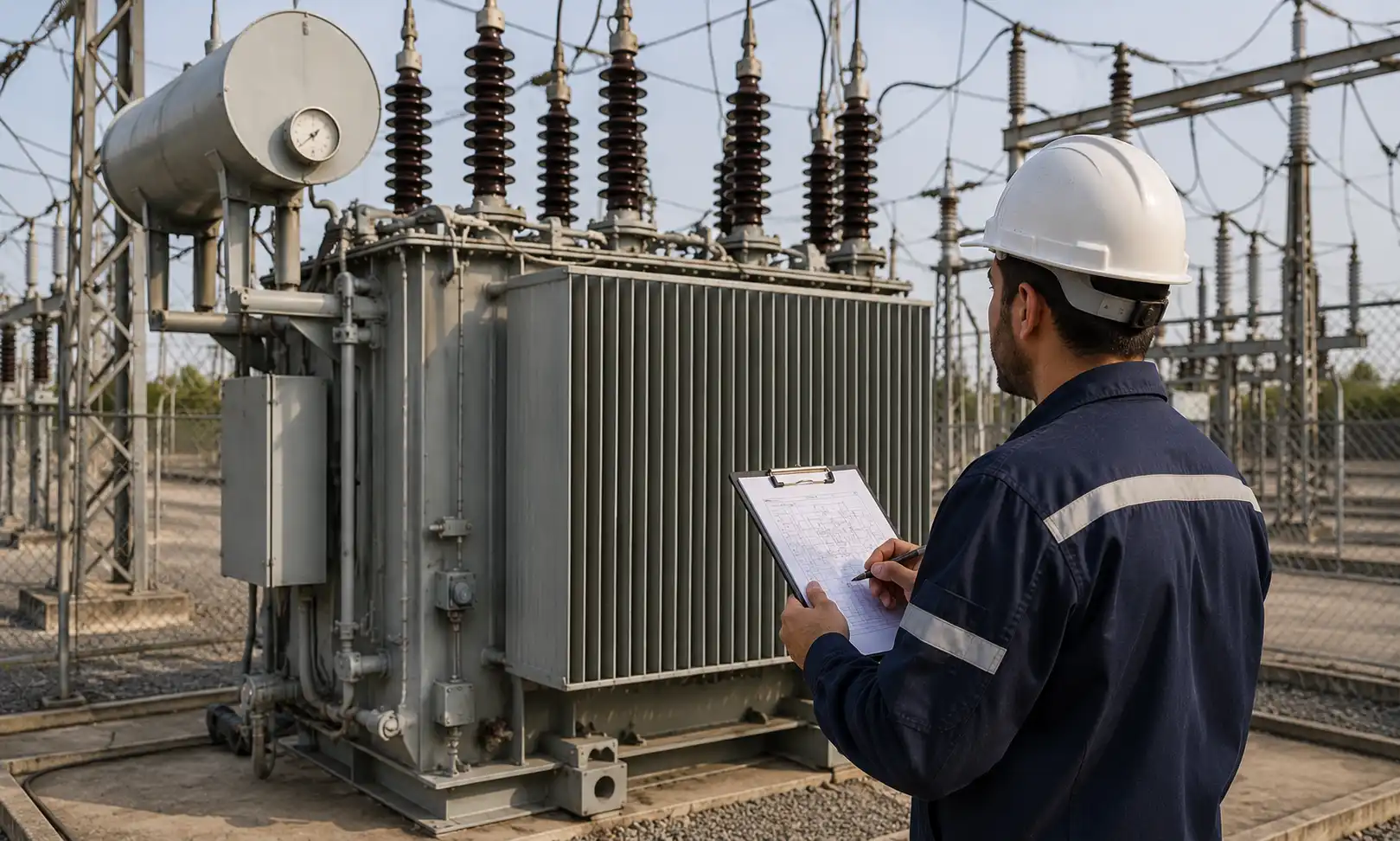
The transformer nameplate is the primary source for all rated parameters, Check for: kVA, primary voltage, secondary voltage, full-load current (both primary and secondary), frequency, and impedance, The nameplate is permanently attached to the transformer tank or enclosure and must be verified before energization.
Method 2 – Calculate from voltage and current
When nameplate data is unavailable, use the following formulas per IEEE C57.12.00:
- Single-phase: kVA = (V × I) / 1,000
- Three-phase: kVA = (V × I × 1.732) / 1,000
Where V = secondary voltage (volts) and I = secondary full-load current (amps), Always add a 20–25% safety margin above calculated load to accommodate load growth and inrush current.
Method 3 – Use dissolved gas analysis (DGA) for in-service transformers
For in-service oil-filled transformers, DGA per IEEE C57.104 provides the condition baseline – confirming whether the existing transformer is operating within its rated thermal envelope before relying on nameplate values for load planning.
Read More : Prevent Faults with Oil Type Transformer Protection Systems
Types of Transformer Ratings
Understanding how to find transformer rating requires knowing the full classification system, This is how how is transformer rated across different application categories:
| Rating Type | Parameter | Typical Values |
| Voltage rating | Primary / Secondary voltage | 11 kV / 0.4 kV; 33 kV / 11 kV; 132 kV / 33 kV |
| Power rating | kVA or MVA | 25 kVA – 100 MVA (distribution to power) |
| Current rating | Full-load amps | Calculated from kVA ÷ (V × 1.732) for three-phase |
| Cooling rating | ONAN / ONAF / OFAF | ONAN = oil natural, air natural (standard) |
| Insulation class | Temperature rise | 55°C / 65°C (oil); 80°C – 150°C (dry-type) |
| Impedance | %Z | 4–6% distribution; 6–12% power transformers |
Read More : What is a Dry Type Distribution Transformer?
Calculating load requirements before choosing a transformer size
Before applying the formulas for how to find transformer rating, calculate the total connected load accurately, Here is how to how to find rated current of transformer requirements step by step:
- List all connected loads: Compile kW or kVA for every load – motors, lighting, HVAC, UPS, and process equipment
- Apply demand factor: Not all loads run simultaneously – apply demand factors (typically 0.6–0.8 for commercial; 0.7–0.9 for industrial) to determine actual peak demand
- Convert kW to kVA: Divide total kW by power factor (typically 0.8) to obtain required kVA: kVA = kW ÷ 0.8
- Add 20–25% growth margin: Apply a minimum 20% upward margin to accommodate load growth and inrush peaks
- Select standard kVA size: Round up to the nearest standard size – single-phase: 25, 37.5, 50, 75, 100 kVA; three-phase: 30, 45, 75, 112.5, 150, 225, 300, 500 kVA
This process also answers how to find rated current of transformer output: divide selected kVA by (secondary voltage × 1.732) for three-phase, or by secondary voltage for single-phase.
Chckele’s Transformers Where Durability Meets High Performance
Chkhele manufactures distribution and power transformers with full nameplate transparency – every unit delivers complete data for how to find transformer rating parameters and how to how to find current rating of transformer capacity at any load level.
Every Chkhele transformer is engineered for maximum service life and performance:
- IEC 60076 and IEEE C57.12.00 certified: Full nameplate data, test certificates, and routine test reports supplied with every unit – per IEC 60076
- Multiple voltage tap positions: ±2.5% and ±5% taps as standard – enabling voltage adjustment for varying network conditions without equipment replacement
- ONAN / ONAF / OFAF cooling options: Matched to site ambient temperature and loading profile – maximizing efficiency and minimizing cooling losses
- Impedance optimized for application: Standard 4–6% for distribution; custom %Z available for fault current management in dense urban networks
- DOE-2016 / IEC 60076-20 efficiency compliance: Premium efficiency cores minimizing no-load and load losses across the full service life
FAQs
How do I figure out my actual load needs?
List all connected loads in kW, apply demand factor (0.6–0.9), divide by power factor (0.8) to get kVA, then add 20–25% growth margin, This gives the minimum how to find transformer rating input you need.
Why does Power Factor change the size I need?
Transformers are rated in kVA – apparent power, At lower power factor, more kVA is required to deliver the same kW – so a lower-PF load always requires a larger transformer than a unity-PF load of the same kilowatt value.
How much extra space should I leave for future growth?
Engineering best practice for how to find transformer rating sizing recommends a 20–25% margin above calculated peak load – accommodating load growth, inrush peaks, and new equipment without transformer replacement.
Do weather and location really change a transformer’s rating?
Yes – ambient temperature above 40°C requires derating per IEEE C57.91. High altitude (above 1,000 m) reduces cooling efficiency, Coastal locations require higher insulation class and IP-rated enclosures for salt spray resistance.
Can I use a transformer with a higher rating than I need?
Yes – oversizing is safe, but reduces efficiency at light loads, For how to find transformer rating optimization: avoid operating below 30% of rated kVA consistently, as fixed core losses dominate and overall efficiency drops significantly.
