

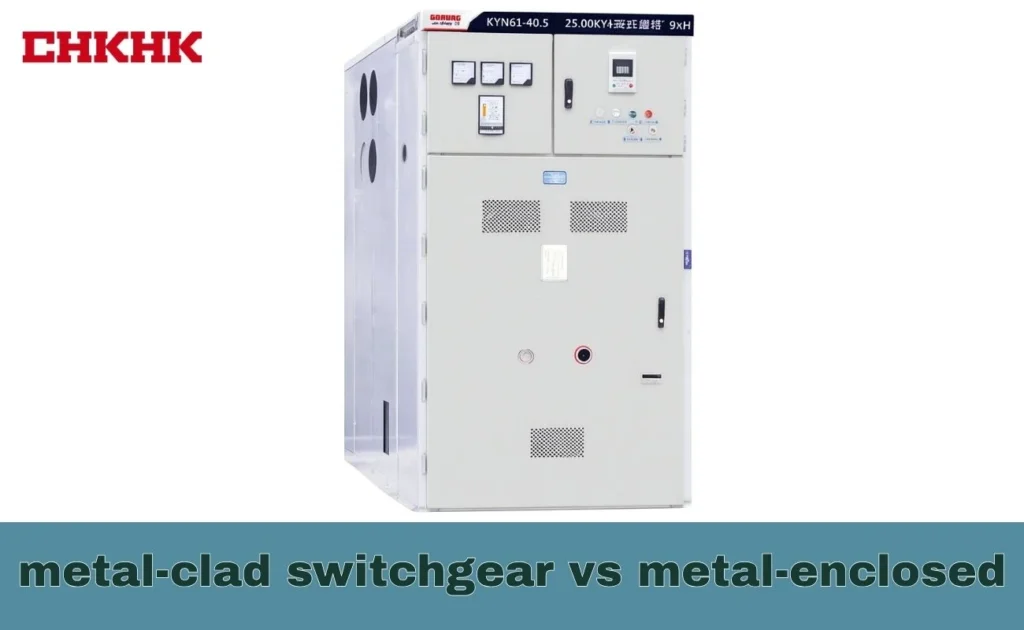
The choice between metal-clad switchgear vs metal-enclosed is a critical technical decision for industrial power distribution projects that require high reliability, This selection impacts long-term safety and operational continuity, as each design differs fundamentally in its internal compartmentalization, protection levels, and voltage management, By understanding these technical distinctions, engineers can ensure that their electrical infrastructure meets specific project demands while minimizing risk, This guide provides a detailed analysis of both systems to help you make an informed procurement decision for your facility while ensuring the highest safety standards.
What is metal-clad switchgear ?
Metal-clad switchgear is a type of power distribution panel designed specifically for medium-voltage applications, where each internal component is housed in its own grounded metal compartment per IEEE C37.20.2.
Internal Design
- Every component (circuit breakers, busbars, and cable connections) is separated by an individual metal barrier.
- This prevents any electrical fault from spreading to adjacent units.
Voltage Range and Draw-Out Breakers
- It operates in the medium-voltage range of 2.4 kV to 38 kV.
- Uses draw-out circuit breakers that allow any unit to be removed for maintenance without shutting down the entire system.
- Automatic Shutters
- Live compartments close automatically when any unit is removed.
- Provides direct protection to maintenance personnel during servicing operations.
Read More : difference between primary and secondary transformer’s Winding
What is metal-enclosed switchgear ?
Metal-enclosed switchgear is the broader category under which several types fall , all housing their components within a single metal enclosure per IEC 62271-200.
Single Enclosure Structure
All components including breakers, busbars, and cable connections share one enclosure without internal metal barriers, simplifying the design and reducing initial cost.
Voltage Range and Application
Primarily suited for low-voltage systems up to 1 kV with medium-voltage versions available, it is used in applications with less complex protection requirements.
Maintenance and Access
Accessing any single component typically requires shutting down the entire section, which directly affects operational continuity in sensitive facilities.
Read More : Low voltage switchgear manufacturers
Metal-clad switchgear vs metal-enclosed
The core difference in comparing metal-clad switchgear vs metal-enclosed centers on internal compartmentalization, protection level, and voltage range , in a global market valued at USD 116.9 billion in 2024 per IMARC Group.
The following table summarizes the key differences between both types:
To simplify the metal-clad switchgear vs metal-enclosed comparison, the following table summarizes the key differences:
| Feature | Metal-Clad | Metal-Enclosed |
| Compartmentalization | Individual metal compartments per component | Single shared enclosure |
| Voltage Range | 2.4 kV , 38 kV | Up to 1 kV (medium-voltage versions available) |
| Circuit Breakers | Draw-out, removable | Fixed in most cases |
| Arc Protection | High , fault contained within its compartment | Basic , fault may spread |
| Cost | Higher | Lower |
| Standard | IEEE C37.20.2 | IEC 62271-200 |
Read More : Choosing the Best Combiner Box Manufacturers for PV Systems
Space Requirements in metal enclosed vs metal clad switchgear
The debate over metal-clad switchgear vs metal-enclosed also involves space requirements, which are a decisive factor in designing electrical rooms.
Depth and Width
Metal-clad panels are deeper due to separate compartments, but allow stacking breakers two-high in a single 36-inch-wide section, reducing the overall horizontal footprint significantly.
Maintenance Clearances
Metal-clad requires wider front-access corridors for safely pulling out breakers, while metal-enclosed offers greater layout flexibility due to its smaller overall dimensions.
Future Expansion
Metal-clad supports modular additions without modifying the original structure, making it the preferred choice for facilities planning future capacity growth.
Typical Applications for Metal Clad Switchgear in Industrial Plants
Metal clad switchgear dominates critical industrial applications , with 30,000 arc flash incidents recorded annually per the 2020 Industrial Safety and Hygiene Report, advanced protection is a necessity, not an option.
Chemical and Petrochemical Plants
Used in production lines and substations within chemical and petrochemical plants, where arc flash risk threatens both personnel safety and operational continuity simultaneously.
Power Generation Facilities
The first-choice solution in conventional and renewable power stations, ensuring any fault is isolated without triggering a full system shutdown.
Data Centers and Critical Infrastructure
Data centers, hospitals, and airports rely on it to guarantee uninterrupted power supply and drive downtime as close to zero as possible.
Beyond the Initial Purchase Price of Switchgear
In the metal-clad switchgear vs metal-enclosed evaluation, looking beyond the initial purchase price is critical, While the upfront cost is lower for one, a professional Life Cycle Cost (LCC) analysis.
- Downtime Prevention: Because metal-clad units allow for maintenance on individual breakers while the rest of the bus remains energized, facilities avoid the massive financial losses associated with full-plant shutdowns.
- Longevity: The superior insulation and compartmentalization of metal-clad designs reduce the rate of component degradation, leading to a longer operational lifespan and higher resale or scrap value.
- Insurance Premiums: High-safety specifications often lead to lower insurance premiums for industrial facilities, as the risk of a catastrophic, facility-wide fire is significantly mitigated by arc-containment features.
Why choose Chkhele switchgears for your project ?
Chkhele switchgears are engineered to meet the highest reliability and safety standards in industrial projects, in a sector projected to reach USD 172.3 billion by 2033 per IMARC Group.
International Standards Compliance
Chkhele products comply with IEC 62271-200 and IEEE C37.20.2, ensuring acceptance in international projects and government tenders without technical barriers.
Performance in Harsh Environments
Designed to operate under high heat, humidity, and dust conditions , making them fully suited for the Middle East, Africa, and demanding industrial environments.
End-to-End Project Support
Chkhele provides integrated engineering support from design through commissioning, reducing delivery timelines and ensuring each product precisely matches project specifications.
Smart Monitoring & Digital Integration in Modern Metal-Clad Systems
Modern power distribution is moving toward Industry 4.0, and the latest metal-clad designs are at the forefront of this digital transformation.
- Predictive Maintenance: Unlike traditional systems, modern metal-clad switchgears can be equipped with thermal sensors and humidity monitors that provide real-time data to operators.
- IoT Connectivity: Systems like those offered by Chkhele can integrate with SCADA and Building Management Systems (BMS), allowing engineers to monitor breaker status and energy quality remotely.
- Enhanced Safety: Digital relaying and remote-racking capabilities allow personnel to operate the switchgear from a safe distance, virtually eliminating the risk of injury during switching operations.
FAQ
Is metal-clad switchgear always more expensive than metal-enclosed?
Generally yes, as compartmentalized design requires more materials and precision manufacturing, However, a proper evaluation must account for the full lifecycle cost , metal-clad significantly reduces maintenance expenses and production downtime over time, making it the more economical choice in many long-term scenarios.
Which type offers better protection against internal arc faults?
Metal-clad provides substantially higher protection by containing any arc flash within the compartment where it originates, without affecting adjacent units, Metal-enclosed lacks sufficient internal barriers, allowing faults to spread and cause wider system damage.
Why is metal-clad switchgear considered safer for maintenance personnel?
Its compartmentalized design allows a technician to work on one component while the rest of the system remains energized, Combined with the automatic shutter system that closes live openings the moment any unit is removed, exposure risk to live voltage is reduced to the lowest possible level.
References:
- IMARC Group , Global Switchgear Market Report 2024
- IEEE Xplore , Safety Benefits of Arc-Resistant Metal-Clad Switchgear
- Electrical Engineering Portal , IEC 62271-200 Installation Guidelines
- IndustryARC , Switchgear Market & Arc Flash Statistics
