

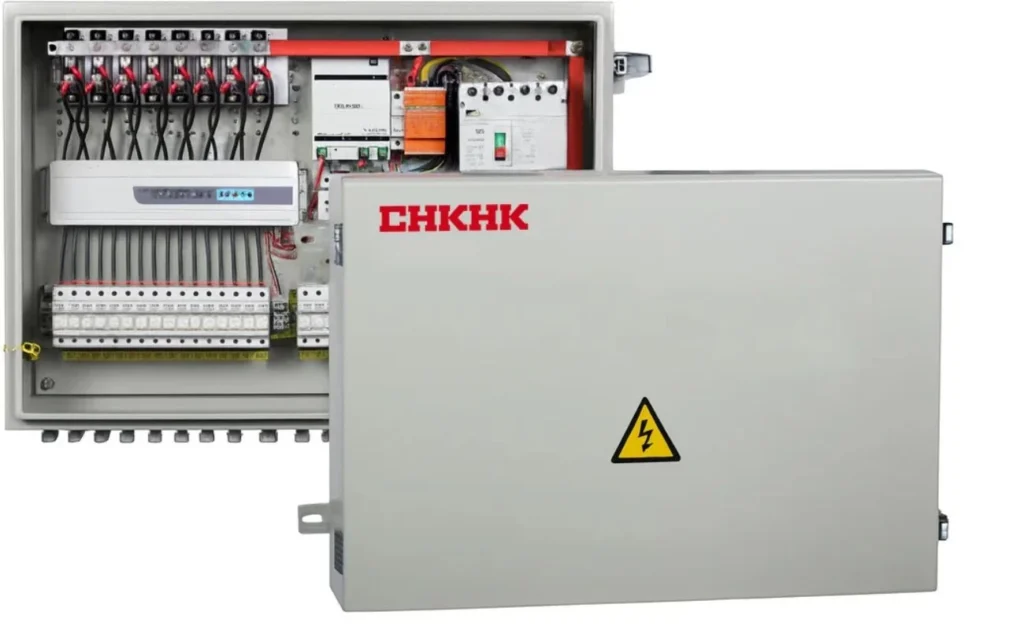
In a solar power system, safety and protection equipment such as fuses and surge protection devices are integrated into a PV combiner box. The equipment inside the box protects each PV module from fault currents and lightning surges. The PV combiner box is a critical component and a good quality box makes the whole PV system more reliable. Solar combiner box manufacturers provide a high quality box to reduce the number of wires and connectors that are tied into the inverter, increase the energy collection from the PV modules, and be more reliable as the combiner box will be the first component to fail in the system.
What is a combiner box ?
A combiner box is among the different types of equipment used in solar energy systems. first, it serves to merge the outputs of several PV strings into one connector. Second, it contains a number of protective devices to keep the system from damage. These devices include fuses, circuit breakers, and lightning surge protection to prevent damage to the system from lightning surges.
Maintaining solar systems is simplified using a combiner box because malfunctioning PV strings can be quickly isolated from the rest of the solar system. The large commercial and utility scale solar systems are commonly where combiner boxes are used. The combiner boxes are used in large scale solar energy systems to meet standard requirements for long term operation and safety.
The Different Types Of Solar Combiner Boxes?
Depending on system designs, voltage levels, and installation specifications, various solar combiner box manufacturers produce them to optimize both the efficiency and the safety of the operation of PV systems.
- DC combiner boxes: Combine multiple outputs of photovoltaic (PV) strings providing one DC output to the inverter.
- AC combiner boxes: Combine outputs of several inverters on the AC side, for feeding to the grid or a load (distributed load).
- String combiner boxes: Designed for smaller systems; they integrate several PV strings with fuses and protection devices, providing means of disconnection.
- Central combiner boxes: Used in large-scale solar plants; they manage multiple inputs with a higher current-carrying capacity.
- Intelligent combiner boxes: Have monitoring devices that provide information and results related to the performance of the individual strings as well as the voltage and current in real time.
How to Choose combiner box manufacturers ?
The importance of selecting among solar combiner box manufacturers is to assure the safety, efficiency, and longevity of the solar power systems in different operating and environmental conditions.
- To ensure the manufacturer is compliant to IEC standards, and standards of equivalent electrical safety and performance.
- Used components, which are of high quality, are tested and proven to be reliable and to be of high quality.
- Customization, to design combiner boxes pertaining to specific system and project criteria.
- Experience in manufacturing solar and electrical devices.
- Testing and quality control, to ensure that the devices are inspected and tested in performance, to ensure that they are tested and proven to be reliable.
- Technical Support, is made available for the engineering installation, and after the installation, to make the system to work.
Essential Safety Standards for Combiner Box Brands
Safety standards must be adhered to when choosing brands of combiners boxes to ensure safe, reliable, and durable function of the electrical components in the solar power system.
- Compliance to IEC standards means that the enclosure of the low voltage assembly covers as well as the performance and safety of the design are all compliant to IEC 61439 standards.
- Overcurrent protection means that the PV strings are protected against faults by means of appropriately rated fuses or circuit breakers.
- Surge protection means the use of surge protection devices (SPDs) to assure protection to the components against lightning and transient overvoltages.
- Ingress protection (IP rating) enclosures should be IP65 rated to guarantee that the enclosure is weatherproof and for outdoor use.
- Grounding and bonding must be designed so that the personnel are protected and the system is safe.
- Thermal management means that the components must be designed in a way that heat is adequately dissipated to avoid overheating and failure of the components.
Global Supply Chain Success of Chkhele Combiner Box Brand
With advanced manufacturing capabilities and international certifications, the Chkhele Combiner Box brand has succeeded in the global supply chain by integrating its extensive exports with its ability to meet the varying demands of solar projects across the globe.
- Extensive global export network: Combiner box products are supplied to different continents: Europe, Africa, the Middle East, and Asia to help international solar projects.
- International standards compliance: Products are market-accepted because they are designed and certified of IEC, and CE standards among others.
- Strong manufacturing capabilities: Sophisticated factories and automated systems allow large scale and homogeneous supply to all global demands.
- Integrated research and development capabilities: Innovative engineering teams devoted to research and development on products improvements to ‘s solar technology.
- Increased global adoption by the diverse application support of products used in solar systems of residential, commercial, and utility scale.
- Timely project execution in international markets with established export experience: reliable logistics and delivery.
- Consistent products quality and ISO certified reliability achieved by quality assurances systems.
Quality Control Practices at Combiner Box Plants
Safe and renewable energy combiner boxes help sustain the function and longevity of solar energy installations. Quality assurance at combiner box plant’s help warranties the reliability and performance of each combiner box produced.
- Checking the quality of the box enclosures, fuses, surge protective devices, and internal wiring prior to production
- Follow standardized assembly guidelines to ensure the same installation process, and provide equal torque and tightness to each connector.
- Quality remains constant throughout the assembly process by catch defects and deviation earlier in the process.
- Examine components of the box to ensure durability of temperature, humidity, and UV exposure.
- Prior to shipment, ensure all parts and components of the box meet IEC and other guidelines of the customer’s country.
- Collect, synthesize, and analyze data to show compliance to government standards.
- Identify weaknesses in the assembly and correct them.
Why Chkhele is the best combiner box manufacturers
Chkhele is one of the top combiner box manufacturers thanks to its excellent products, innovative designs, and exceptional global compliance and reliability in residential, commercial and utility-scale solar projects.
- Custom-fabricated boxes for different voltage and environmental conditions
- High-grade materials in surge protective/weather-resistant housing
- Compliant to IEC and CE certification criteria
- Processed in state-of-the-art facilities
- Engineering and installation assistance and after-sales support
- Timely provision of products for solar projects across the globe
- Smart system and monitoring solutions
- Residential and commercial utility-scale proven trusted installs
FAQs
Do manufacturers provide smart monitoring features in their boxes?
Different combiner box manufacturers provide smart monitoring capabilities including tracking string currents and voltages in real time, notifying users of faults, communicating data for maintenance, and improving maintenance and performance tracking of systems.
How do manufacturers test their products for extreme weather?
To verify how combiner boxes endure extreme weather, manufacturers conduct simulated environments testing, such as temperature and humidity cycling, UV exposure, salt fog, and rain tests.
