

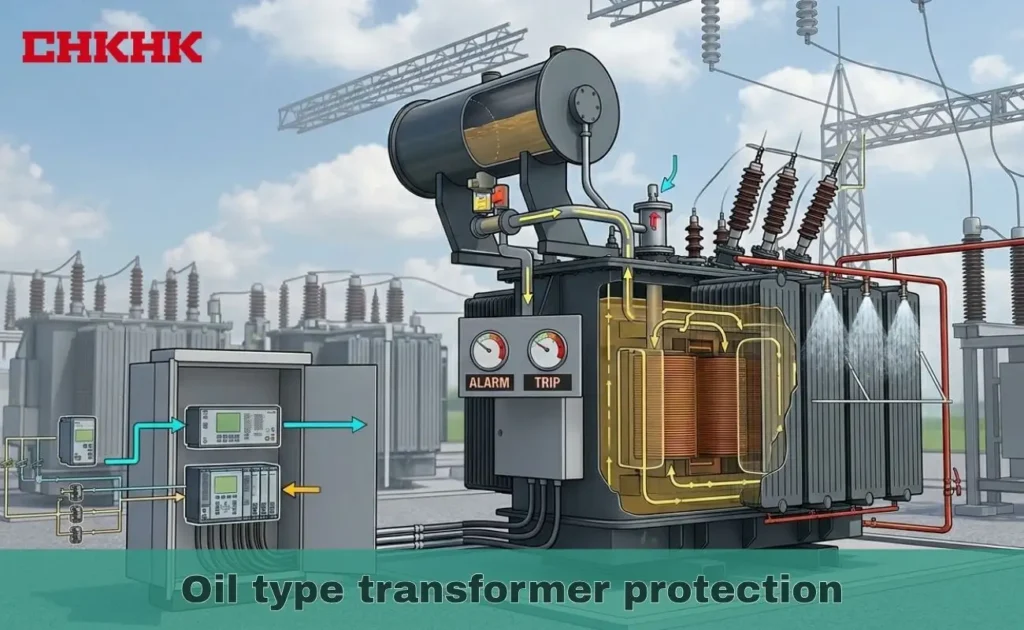
Oil type transformer protection is the combined system of electrical and mechanical safeguards that prevent internal and external faults from destroying distribution and power transformers, Per IEEE Standard 493, transformer failures account for significant network downtime making a correctly designed oil type transformer protection scheme the most cost-effective investment in power system reliability.
What is oil type transformer protection ?
Oil type transformer protection refers to the coordinated set of devices relays, sensors, fuses, and mechanical monitors that detect abnormal conditions and isolate the transformer before damage can propagate, A complete transformer protection scheme addresses three fault categories: internal electrical faults, external system faults, and abnormal operating conditions such as overloading and cooling failure.
Read More : What is a Dry Type Distribution Transformer ?
Why oil transformers need dedicated protection
Oil-immersed transformers contain a large volume of flammable dielectric fluid under continuous thermal and electrical stress, Without proper protection:
- Internal arcing degrades insulation and contaminates oil within milliseconds triggering rapid pressure rise and potential tank rupture
- Overloading accelerates insulation aging per IEEE C57.91, every 10°C above rated temperature halves insulation life
- External short circuits generate mechanical forces that can deform windings permanently even if the transformer survives electrically
Read More : Causes of Transformer Oil Leakage: A Technical Guide to Prevention
oil type transformer protection methods
The full range of oil type transformer protection methods divides into electrical and mechanical categories. Comprehensive oil transformer protection requires both layers working together:
Electrical protection:
- Differential protection: Compares input/output currents any imbalance indicates an internal fault; primary protection for transformers above 5 MVA per IEEE C37.91
- Overcurrent protection: HRC fuses for units up to 1 MVA; overcurrent relays with circuit breakers for larger units set above inrush current (8–12× rated)
- Restricted Earth Fault (REF): Detects earth faults within the winding that differential protection may miss effective for star-connected solidly grounded neutrals
- Overcurrent and earth fault relay: Backup protection for external faults outside the differential zone
Read More : Top Power Distribution Transformer Manufacturers
Mechanical protection:
- Buchholz relay: Detects slow gas accumulation (alarm) and sudden oil displacement (trip) standard on all conservator-type oil transformers
- Pressure Relief Device (PRD): Releases dangerous pressure from internal arcing operates faster than the Buchholz relay for high-energy faults
- Oil temperature indicator (OTI): Alarm at first threshold, trip at second prevents thermal runaway
- Winding temperature indicator (WTI): Monitors hottest-spot temperature critical thermal parameter per IEEE C57.91
Read More : Components Of Substation and Their Functions
components of oil type transformer protection
Every oil type transformer protection assembly incorporates the following core components each with a defined function in the overall protection scheme:
| Component | Function | Fault Type Detected |
| Differential relay | Compares input/output current balance | Internal winding and bushing faults |
| Buchholz relay | Detects gas and oil movement | Slow insulation degradation + major internal arcing |
| Overcurrent relay + CB | Trips on fault current exceeding setting | External short circuits and overloads |
| REF relay | Detects earth faults inside winding zone | Winding earth faults below differential threshold |
| Pressure Relief Device | Releases excess tank pressure | High-energy internal arcing |
| Oil Temperature Indicator | Monitors oil temperature | Overloading and cooling failure |
| Winding Temperature Indicator | Monitors hotspot winding temperature | Thermal overload and insulation aging |
| Oil Level Indicator | Monitors oil volume in conservator | Oil leaks and moisture ingress |
Types of oil transformer protection
Per IEEE C37.91 the primary standard for transformer protection relay applications oil type transformer protection is classified into three tiers:
- Primary protection: Acts instantaneously for internal faults differential protection and Buchholz relay are the main primary protection devices
- Backup protection: Operates if primary protection fails overcurrent relays, REF protection, and impedance protection form the backup layer
- Abnormal condition protection: Monitors non-critical conditions that require operator intervention overload, over-excitation (V/Hz), oil level, and cooling system failure alarms
Comparing mechanical and electrical protection methods for oil units
A complete oil type transformer protection strategy requires both electrical and mechanical layers each covering fault types the other cannot detect:
| Criterion | Electrical Protection | Mechanical Protection |
| Detection basis | Current, voltage, frequency | Gas, oil movement, temperature, pressure |
| Response speed | Milliseconds (relay + CB) | Seconds to minutes (Buchholz, OTI) |
| Fault types covered | Winding faults, earth faults, overloads | Oil decomposition, overheating, tank pressure |
| Bushings faults | Yes differential relay | Partial only Buchholz misses bushing flashovers |
| Required for | All transformer sizes | Conservator-type oil transformers only |
Overcurrent and earth fault protection in distribution transformers
For distribution transformers, overcurrent and earth fault protection forms the backbone of oil transformer protection at the network level, Per IEEE C37.91, the key requirements are:
- Fuse sizing: HRC fuses for units up to 1 MVA rated above maximum load current and must withstand inrush (8–12× rated for 0.1–0.5 seconds)
- Relay settings: Overcurrent relays set at 150–200% of maximum load current coordinated with downstream fuses through time-current curves
- Earth fault detection: Zero-sequence overcurrent protection covers high-impedance ground faults where differential protection may not respond
- Coordination with upstream protection: Transformer protection must coordinate with feeder reclosers and upstream breakers isolating only the faulted transformer, not the entire feeder
Challenges of protecting transformers against external short circuits
External short circuits generate fault currents that flow through the transformer without triggering differential protection yet still cause mechanical and thermal damage:
- Through-fault withstand limits: Per IEEE C57.91, frequent external faults accumulate mechanical winding damage even without electrical tripping
- Inrush current discrimination: Differential relays must distinguish fault currents from magnetizing inrush second harmonic restraint prevents incorrect tripping during energization
- CT saturation: High fault currents saturate current transformers, causing false differential currents high-stability relays with percentage restraint are required
- Fast reclosing impact: Reclosing onto a faulted transformer before de-magnetization generates cumulative mechanical stress coordinated reclosing delays are mandatory
Features of Chkhele’s transformers
Chkhele designs every transformer with integrated oil type transformer protection devices factory-fitted and tested reducing site risk and ensuring coordination from day one:
- Factory-fitted Buchholz relay: Pre-wired and tested alarm and trip contacts verified before dispatch
- OTI and WTI dual-threshold settings: Calibrated to IEEE C57.91 alarm at 95°C, trip at 105°C
- Pressure Relief Device (PRD): Rated for transformer tank volume prevents rupture during internal arcing
- IEC 60076-certified design: Meets through-fault withstand requirements protecting against mechanical winding damage
- Protection coordination support: Time-current data provided for relay setting engineers ensuring correct feeder and substation integration
FAQs
Why Is Safety Important When Operating Oil-Immersed Transformers?
Oil-immersed transformers contain flammable dielectric fluid under high voltage a fault without proper protection can cause arc flash, oil fire, or tank explosion, endangering personnel and causing catastrophic equipment loss.
What Fire Protection Measures Should Be in Place for Oil-Immersed Transformers?
Per NFPA 850, oil-immersed transformers require: oil containment pits sized for full oil volume, separation distance from buildings, automatic fire suppression systems, and pressure relief devices all mandatory for indoor or substation installations.
