

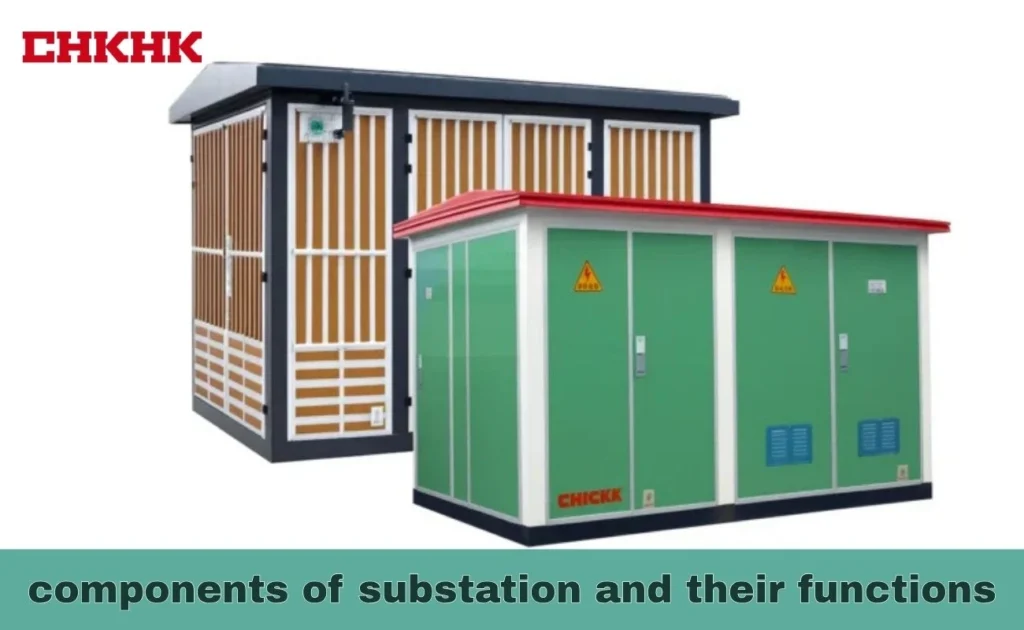
The components of substation and their functions form the critical link between high-voltage transmission lines and end consumers across Africa, According to the IEA (2025), nearly 600 million people in Africa still lack reliable electricity access – making investment in well-designed substation infrastructure one of the continent’s most urgent priorities for utilities and project developers.
What is a Substation?
A substation is a high-voltage facility that transforms, switches, and controls electrical power between transmission and distribution networks, Understanding the components of substation and their functions begins with knowing that every substation serves four core roles: voltage transformation, circuit switching, fault protection, and power quality management.
Types of substations
Substations across African power networks are classified based on their role in the grid:
- Step-up transmission substations: Raise generation voltage (11–23 kV) to transmission levels (132–500 kV) for long-distance delivery
- Step-down transmission substations: Reduce transmission voltage to sub transmission levels (33–69 kV) at switching points in the grid
- Distribution substations: Step down sub transmission voltage to utilization levels (11 kV, 415 V) for delivery to industrial and residential consumers
Read More : Top Power Distribution Transformer Manufacturers | Chkhele
What are components of substation and their functions?
The components of substation and their functions span multiple equipment categories – each essential to safe, continuous power delivery.
Power transformers and substation transformer parts
The power transformer is the core of every substation, Substation transformer parts include the primary and secondary windings, core, oil-filled tank, bushings, tap changer, and cooling system, Per IEA grid infrastructure data, transformers have a design lifetime of 30–40 years – making correct specification and maintenance critical for African utilities operating aging infrastructure.
Switchgear and circuit breakers
Switchgear encompasses all devices that control, protect, and isolate electrical circuits, The substation components and their functions in this category include:
- Circuit breakers: Automatically interrupt fault current – available in SF6, vacuum, and air-blast types for different voltage classes.
- Disconnect switches (isolators): Provide visible open-circuit isolation for maintenance – must only be operated under no-load conditions.
- Load break switches: Allow energized switching of circuits under load current without fault interruption capability.
Main functions of a substation in power transformation and distribution
Beyond individual equipment, the components of substation and their functions work as an integrated system to deliver four main grid functions.
- Voltage transformation: Power transformers step voltage up or down to match transmission and distribution requirements – minimizing energy loss over long distances
- Circuit switching: Circuit breakers and switches connect or isolate transmission and distribution lines as needed for load management or emergencies.
- Fault protection: Protection relays detect abnormal conditions and signal circuit breakers to isolate the faulted section in milliseconds – limiting damage and outage extent.
- Power quality management: Capacitor banks, reactors, and voltage regulators maintain stable voltage and power factor across the distribution network.
The role of breakers in substation
Circuit breakers are the primary fault-clearing devices within any components of an electrical substation layout – they determine how fast a fault is isolated and how much of the network is affected.
Circuit breaker types and selection
The main circuit breaker types deployed in African substation projects are:
- SF6 gas circuit breakers: Standard for high-voltage applications (72.5 kV and above); high interrupting capacity and compact design.
- Vacuum circuit breakers: Preferred for medium-voltage (11–33 kV) distribution substations; low maintenance and long service life.
- Air circuit breakers: Used at low-voltage levels (up to 1 kV) for secondary distribution protection in industrial and commercial facilities.
what are other protection components in substation?
Beyond circuit breakers, several devices complete the components of substation and their functions picture. These substation components include:
- Protection relays: Detect overcurrent, differential, and earth fault conditions – send trip signals within milliseconds.
- Lightning arresters: Divert lightning surge current to earth, protecting transformer insulation from transient overvoltages.
- Instrument transformers (CTs/VTs): Reduce high values to measurable levels (1–5A, 110V) for protection relays and metering.
- Busbars: Copper or aluminum bars that collect incoming power and distribute it to outgoing feeders – the central junction of the substation.
- Capacitor banks: Improve power factor and provide reactive power compensation on heavily loaded feeders.
Read More : Components of Power Distribution System | 2026 Guide
Safety protocols and risk management within the substation perimeter
Safe operation of the components of substation and their functions requires strict protocols at every stage – from commissioning through routine maintenance.
Key safety requirements
The core safety protocols for substation operations per IEEE and IEC standards include:
- Lockout/Tagout (LOTO): All energy sources must be isolated and locked before any maintenance work on energized equipment.
- Clearance distances: Minimum approach distances from live conductors defined per voltage class – IEEE C37.48 and IEC 61936-1 specify applicable clearances.
- Personal protective equipment (PPE): Arc flash rated PPE required for all live work – arc flash hazard analysis per IEEE 1584-2018 determines required PPE category.
- Perimeter security: Physical fencing, warning signs, and access controls to prevent unauthorized entry – critical for unattended distribution substations across rural Africa.
Read More : Combiner Box vs. Junction Box | A Guide to Solar Safety
Role of the substation in power factor correction and voltage stability
Voltage stability is one of the most critical functions performed by the parts of a substation, Poorly regulated voltage causes equipment damage, increased losses, and load shedding – all major operational challenges for African utilities.
Power factor correction equipment
The main components in a substation used for power factor correction and voltage stability include:
- Shunt capacitor banks: Provide reactive power locally, reducing reactive current on transmission lines and improving voltage at load centers.
- Reactors: Absorb excess reactive power during light-load conditions to prevent overvoltage on long transmission lines.
- On-load tap changers (OLTCs): Automatically adjust transformer turns ratio under load to maintain secondary voltage within ±5% of nominal – essential for voltage regulation in African networks with variable load profiles.
Failure Statistics and Common Mistakes in Expulsion Mechanisms
Proper maintenance of all substation parts and equipment is essential most substation failures result from deferred maintenance, not sudden equipment breakdown.
- Routine thermal scanning: Infrared thermography detects hotspots on connections, transformers, and substation components before failure occurs.
- Oil analysis: Dissolved gas analysis (DGA) on transformer oil identifies developing insulation faults per IEC 60599 guidelines.
- Protection relay testing: Secondary injection tests verify relay operation at 12-month intervals for critical protection functions.
Why Chkhele’s Substations are the best for Africa and Middle east
Chkhele delivers certified components of substation and their functions engineered for African and Middle Eastern networks – ensuring all electrical substation components perform reliably under high-temperature, high-humidity, and high-dust conditions:
- IEC-certified transformers and switchgear: Compliant with IEC 60076, IEC 62271, and IEC 61850.
- Africa-optimized engineering: IP-rated enclosures and corrosion-resistant hardware for coastal and desert environments.
- Complete substation solutions: From distribution substation components to full turnkey packages – reducing procurement complexity.
- Technical engineering support: Load flow analysis, protection coordination, and specification assistance.
- Reliable supply chain: Predictable delivery across Sub-Saharan Africa and the Middle East.
For procurement managers seeking all components of substation and their functions – including substation parts and equipment and substation components – that meet international standards, Chkhele is the partner of choice.
FAQs
How does a protection relay function during a substation fault?
A protection relay detects abnormal conditions within components of substation and their functions, sending a trip signal to isolate the fault in milliseconds and limit equipment damage.
What are the key maintenance indicators for substation transformers and switchgear?
Key indicators include transformer oil DGA results, insulation resistance, and relay operating times – benchmarked against IEC 60076 limits for the specific substation transformer parts and switchgear type.
Sources
The following authoritative sources were referenced in preparing this article:
- IEA – Financing Electricity Access in Africa (2025): https://www.iea.org/reports/financing-electricity-access-in-africa/executive-summary
- IEA – Electricity Grids and Secure Energy Transitions: https://iea.blob.core.windows.net/assets/70f2de45-6d84-4e07-bfd0-93833e205c81/ElectricityGridsandSecureEnergyTransitions.pdf
- OSHA – Illustrated Glossary: Substations: https://www.osha.gov/etools/electric-power/illustrated-glossary/sub-station
- IEEE C37.42-2016 – Specifications for High-Voltage Fuses: https://standards.ieee.org/standard/C37_42-2016.html
- IEEE Std. 1366-2012 – Electric Power Distribution Reliability Indices: https://standards.ieee.org/ieee/1366/7243/
