

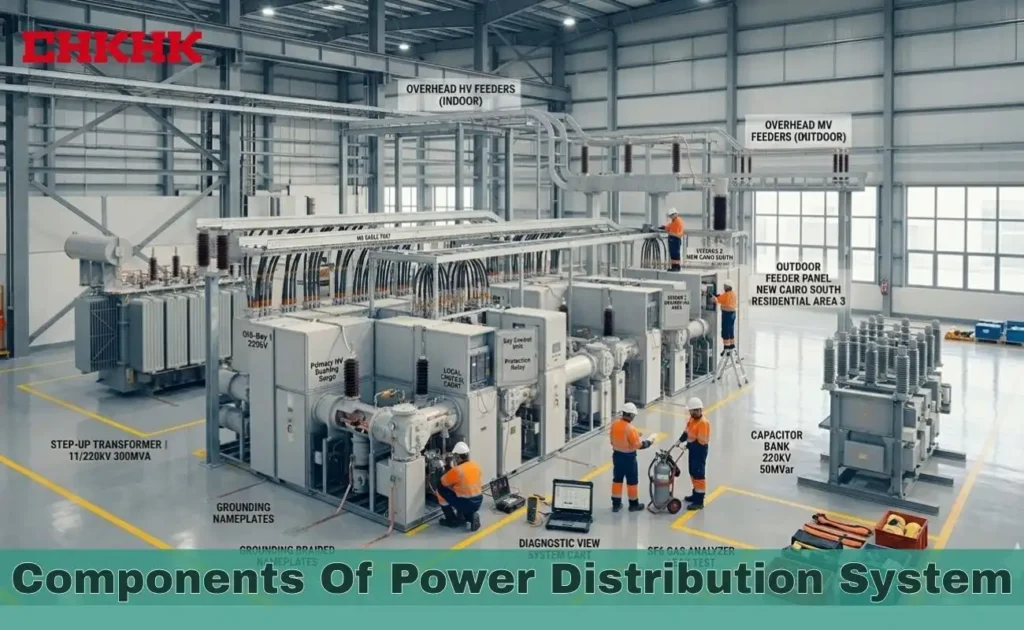
The components of power distribution system determine how reliably electricity reaches homes, factories, and commercial facilities across Africa, According to the IEA (2024), over 600 million people on the continent still lack reliable electricity access – making well-engineered power distribution components a strategic investment priority for utilities and project developers alike.
The strategic role of transformers in voltage regulation
Transformers are among the most critical main components of distribution system networks, governing how voltage is stepped down from transmission levels to usable consumer values, Selecting the right transformer directly impacts the efficiency and safety of every components of power distribution system project.
Read More : components of power distribution system
Primary and secondary transformer functions
The primary winding receives incoming high voltage – stepped down from 33 kV to 11 kV at the substation – while the secondary winding outputs utilization voltage (415 V or 240 V) to end consumers, Key selection criteria include:
- Voltage ratio and impedance per IEC 60076 standards
- Cooling method (ONAN / ONAF) for high-ambient-temperature African climates
- No-load and load losses to minimize long-term energy costs
- Insulation class and dielectric strength for humid or dusty environments
Primary secondary transformer configurations
The most widely deployed primary secondary transformer configuration across African networks is Dyn11 (delta-star), providing a neutral point for single-phase loads, zero-sequence fault current management, and compatibility with primary distribution voltage levels of 6.6 kV, 11 kV, and 33 kV.
Read More : Combiner Box vs. Junction Box | A Guide to Solar Safety
High performance switchgear and its impact on system reliability
Switchgear is the protective and switching core of any electrical distribution system components layout, determining how fast faults are isolated and power is restored after an interruption.
Switchgear types and IEC standards
Modern distribution switchgear falls into three main categories, each suited to different voltage levels and site conditions:
- Air-Insulated Switchgear (AIS): Cost-effective for outdoor substations; widely used across Sub-Saharan Africa for primary distribution voltage levels.
- Gas-Insulated Switchgear (GIS): Preferred for urban or confined substations; provides superior reliability in harsh, dusty, or high-humidity environments common across the continent.
- Vacuum Circuit Breakers: Standard at medium-voltage levels (11–33 kV); fast fault interruption with minimal maintenance requirements – a significant advantage in remote distribution locations.
Procurement managers should verify IEC 62271-200 and IEC 62271-100 compliance for all distribution substation components to ensure long service life under variable load and environmental conditions.
Read More : Difference Between Primary and Secondary Transformer’s Winding
Circuit Protection Devices in power distribution system
Circuit protection is a non-negotiable layer within any components of power distribution system design, These devices detect abnormal conditions and isolate faults before cascading failures occur across the network.
Core protection devices and their roles
The main protection devices integrated into the distribution components layer include:
- Circuit Breakers (MCCBs / ACBs): Automatically interrupt fault current at rated breaking capacity; available in molded-case and air configurations for different current ratings.
- Fuses: Provide cost-effective overcurrent protection; ideal as backup protection for remote distribution line components across rural African grids.
- Surge Protective Devices (SPDs): Guard against lightning-induced voltage transients – a critical requirement given Sub-Saharan Africa’s high annual thunderstorm frequency.
- Ground Fault Protection Relays: Detect insulation failures and leakage currents, essential for personnel safety in industrial and commercial distribution environments.
According to IEEE Standard 1366-2012, over 80% of customer interruptions originate from failures at the distribution layer – reinforcing the importance of properly coordinated protection devices.
Smart monitoring devices for real time grid diagnostics
Integrating smart monitoring into the components of power distribution system enables utilities to shift from reactive repairs to predictive maintenance, measurably reducing outage duration and frequency.
IEC 61850 and Intelligent Electronic Devices
The IEC 61850 standard governs communication between IEDs within substations, enabling real-time data exchange across electrical distribution networks. Via GOOSE messaging, utilities can diagnose asset health remotely and respond to faults in under 4 milliseconds:
- IEDs: Collect voltage, current, and fault data; transmit via IEC 61850 for millisecond-level fault response
- Power Quality Analyzers: Continuously measure harmonics, voltage sags, and frequency deviations to optimize distribution line performance
- SCADA-Integrated Sensors: Enable centralized visibility across multiple substations for large geographic distribution networks
Automation in power distribution system
Automated reclosers, fault indicators, and remote-controlled switches reduce SAIDI – the core reliability benchmark defined in IEEE Std, 1366-2012 – by enabling faster fault isolation without field crew intervention.
Challenges of choosing components of power distribution system
Selecting the right component parts of the electrical distribution network for African markets involves navigating technical, financial, and environmental complexities unique to the region.
Key Procurement and Design Challenges
The most common challenges encountered during distribution system planning and procurement include:
- Climate compatibility: Components must withstand temperatures above 45°C, humidity, dust, and salt corrosion – IP54 or higher ratings required for all outdoor installations
- Grid voltage instability: African networks experience significant voltage fluctuation, demanding wide-tolerance transformers and switchgear with robust regulation capabilities
- IEC vs. local standards: Some national utilities maintain legacy specifications requiring careful technical coordination to align with IEC standards
- Total cost of ownership: Lifecycle analysis consistently favors IEC/IEEE-certified components over lower-cost alternatives with higher maintenance and failure rates
- Supply chain lead times: GIS switchgear and large power transformers carry 16–24 week lead times, requiring careful project scheduling
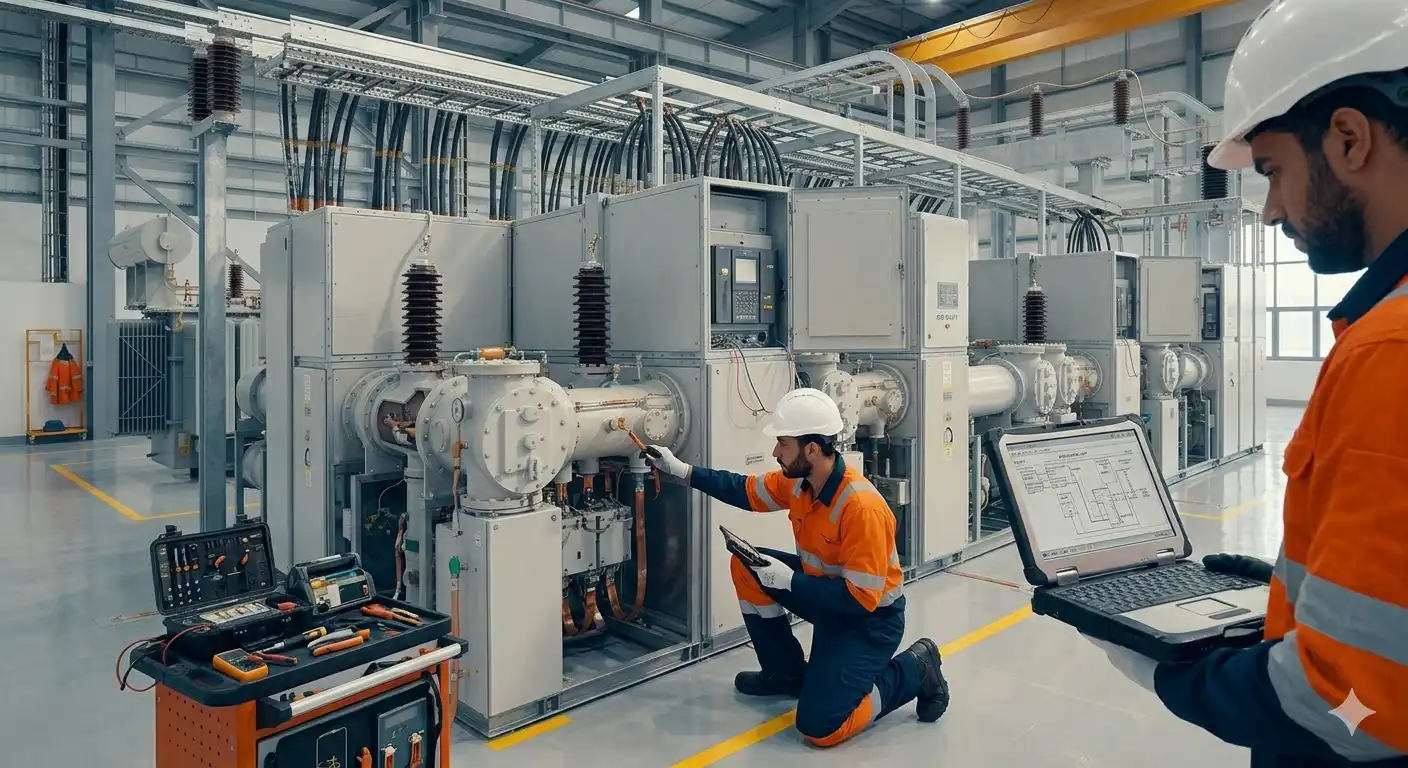
Preventive maintenance strategies for extending component
A structured preventive maintenance program significantly extends the service life of all components of power distribution system assets and reduces the risk of costly emergency failures across the network.
Maintenance schedule by component type
Effective maintenance programs for electrical distribution system components are organized by equipment category and risk level:
| Component | Maintenance Activity | Recommended Interval |
| Distribution Transformer | Oil sampling, insulation resistance test, thermal imaging scan | Every 12 months |
| Circuit Breaker | Contact resistance, timing test, SF6 gas level check | Every 12–24 months |
| Switchgear (GIS / AIS) | Visual inspection, partial discharge test, mechanism lubrication | Every 12 months |
| Protection Relays / IEDs | Functional test, firmware update, calibration check | Every 24 months |
| Surge Protective Devices | Visual inspection, degradation indicator check | Every 6 months |
Condition-based maintenance with IEC 61850
For substations with IEC 61850-enabled IEDs, condition-based maintenance outperforms fixed-interval schedules – IEDs continuously track contact wear, oil temperature, and gas density levels, triggering maintenance only when thresholds are approached.
Chkhele’s components of power distribution system
Chkhele delivers certified, high-performance components of power distribution system engineered for the specific demands of African energy infrastructure – from large industrial grids to rural commercial power distribution system projects.
Why Choose Chkhele
Every product in the Chkhele portfolio is tested to IEC and IEEE standards, ensuring compatibility with regional grid conditions and long-term reliability:
- Full IEC-certified range: Distribution transformers, medium-voltage switchgear, protection relays, and smart IEDs – compliant with IEC 60076, IEC 62271, and IEC 61850
- Africa-optimized engineering: Components specified for high-temperature, high-humidity, and high-dust environments, with IP ratings matched to African deployment conditions
- Engineering support: Specification assistance, load flow analysis, and system integration guidance – reducing procurement risk on every project
- Reliable supply chain: Predictable lead times for critical power distribution components across Sub-Saharan and North Africa
For procurement managers seeking components of power distribution system that meet international standards without compromise, Chkhele is the partner of choice across the continent.
What is the difference between a primary and secondary distribution system?
The primary distribution system operates at medium voltage (3.3–33 kV) supplying large loads, while the secondary system steps down to utilization voltage (240/415 V) for end consumers.
Why should procurement managers prioritize IEC and IEEE certified components?
IEC and IEEE certification guarantees tested safety, performance, and interoperability – reducing failure risk, simplifying maintenance, and satisfying insurance and regulatory requirements on African infrastructure projects.
Sources
- IEA – Access to Electricity 2024: https://www.iea.org/commentaries/access-to-electricity-stagnates-leaving-globally-730-million-in-the-dark
- IEEE Std. 1366-2012 – Electric Power Distribution Reliability Indices: https://standards.ieee.org/ieee/1366/7243/
- IEC 61850 – Communication Networks for Power Utility Automation: https://iec61850.dvl.iec.ch/
- Springer – Power Distribution System Reliability Assessment, Ethiopia (2024): https://link.springer.com/chapter/10.1007/978-3-030-43690-2_28
- OSHA – Illustrated Glossary: Distribution Systems: https://www.osha.gov/etools/electric-power/illustrated-glossary/distribution-system
- IEEE Spectrum – Expanding Electricity Access in Sub-Saharan Africa (2024): https://spectrum.ieee.org/electricity-access-sub-saharan-africa
