
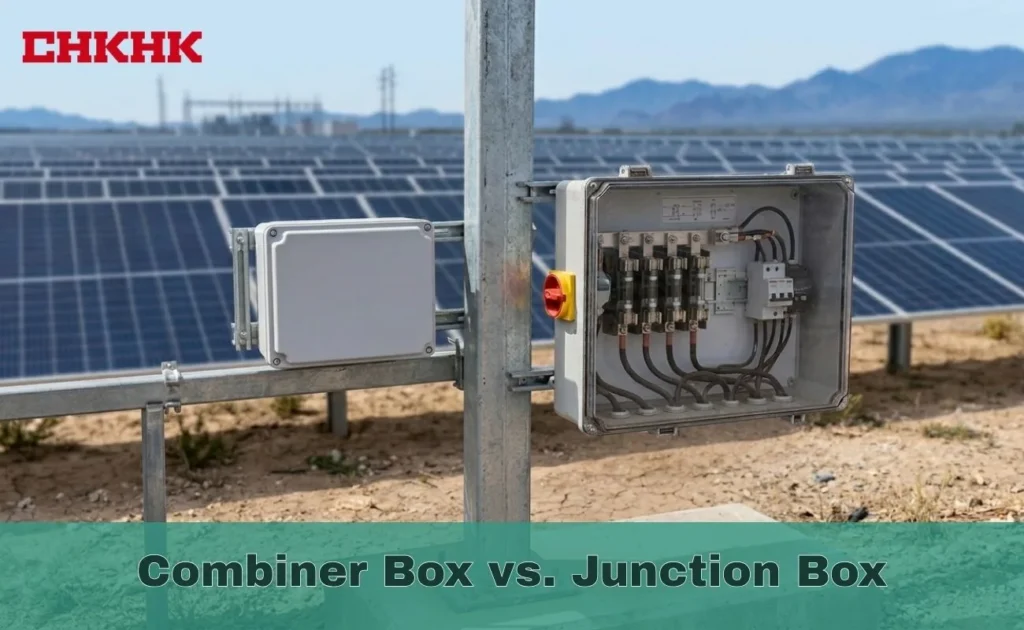
When evaluating Combiner Box vs. Junction Box, most installers discover these two components serve entirely different roles , despite both appearing inside the same solar installation, Choosing the wrong one compromises safety, triggers inspection failures, and increases long-term costs, This guide covers every difference, every use case, and every selection factor you need.
What is Combiner Box?
While both components serve as connection points, understanding the Combiner Box vs, Junction Box differences is crucial for system design, A Combiner Box is an electrical enclosure that collects DC outputs from multiple solar panel strings and merges them into a single protected output before the inverter, It acts as the central hub of your solar array, organizing multiple power streams into one clean, safe circuit.
The following are its core functions:
- Combines 2 to 24 panel strings into one DC output
- Provides per-string overcurrent protection via fuses or circuit breakers
- Includes surge protection device (SPD) against lightning and voltage spikes
- Houses a DC isolator switch for safe maintenance access
- Offers real-time per-string monitoring in smart models
Read More : Choosing Combiner Boxes For Solar System | Chkhele Guide
What is Junction Box?
In the debate of Combiner Box vs. Junction Box, the latter is much simpler in scope, A Junction Box is the small sealed enclosure mounted on the back of every individual solar panel, Its sole purpose is to protect the panel’s internal wire connections from environmental exposure; unlike the combiner box, it does not combine circuits, offer overcurrent protection, or perform any system-level function.
Junction Box internal components include:
- Bypass diodes , redirect current around shaded cells to prevent hot spots and maintain panel output
- MC4 connectors , industry-standard weatherproof connectors linking the panel to string wiring
- Sealed enclosure , protects internal terminations from moisture, dust, and UV exposure
Read More : Low Voltage Switchgear Products
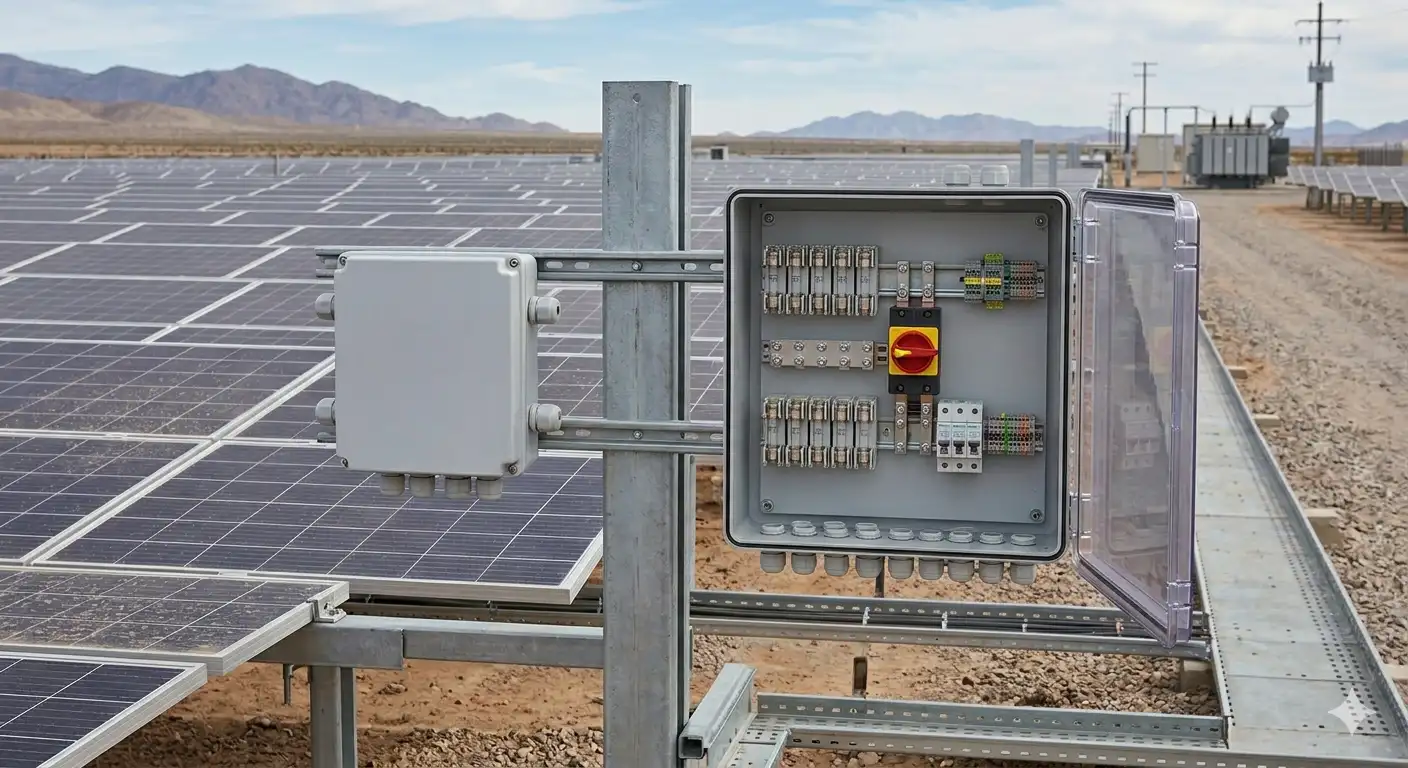
Combiner Box vs. Junction Box
The following is a direct comparison across all key dimensions:
| Feature | Combiner Box | Junction Box |
| Installation Level | System level | Panel level |
| Primary Function | Combines multiple strings | Protects panel wire connections |
| Overcurrent Protection | Per-string fuses / breakers | Not available |
| Surge Protection (SPD) | Built-in | Not available |
| DC Disconnect Switch | Included | Not available |
| String Monitoring | Smart models | Not available |
| Minimum IP Rating | IP65 | IP54 |
| System Size | 3+ strings, medium to large | Every panel, any system size |
The Role of Combiner Box in Solar System
The Combiner Box vs. Junction Box distinction becomes clearest when you examine how combiner boxes operate across different system scales.
- Residential (3–10kW): Simplifies rooftop wiring, reduces cable penetration points, and adds overcurrent protection even where direct inverter connection is technically possible
- Commercial & Industrial (100kW+): Serves as a critical system management node, managing dozens of parallel strings across multiple inverters efficiently
- Utility-Scale: Distributed across massive arrays to reduce long cable runs, cut material costs, and enable fast fault isolation across hundreds of acres
Read More : Metal-Clad Switchgear vs Metal-Enclosed
Choosing Combiner Box vs. Junction Box
Choosing the right component depends on your specific system requirements and safety standards, Here is the decision framework to help you distinguish between the Combiner Box vs. Junction Box based on your project scale:
- Your system has three or more parallel panel strings
- System size exceeds 3kW and requires safety code compliance
- You need per-string fault detection and surge protection
- The installation is commercial, industrial, or utility-scale
Use a Junction Box when:
- You need panel-level wire connection protection only
- Your system uses one or two strings connecting directly to the inverter
- General electrical wiring requires simple, protected connection points
Internal Components of a Solar Combiner Box and Their Purposes
Every reliable combiner box is built around heavy-duty internal components designed for system-level management, Unlike the basic internal wiring of a Junction Box, the Combiner Box vs. Junction Box hardware layout includes:
- Busbars , consolidate all string inputs into a single output; sized for worst-case current and temperature
- DC String Fuses / Circuit Breakers , one per string; isolates faults instantly without shutting down the entire array
- Surge Protection Device (SPD) , Type 2 for standard rooftops; Type 1+2 for high-lightning-risk sites per IEC 61643-31
- DC Isolator Switch , enables full safe disconnection for maintenance without system shutdown
- Blocking Diodes , prevent reverse current flow from healthy strings into a faulty string
- Smart Monitoring Module , live per-string data via RS-485 or Ethernet to inverter or SCADA
Global Safety Standards for Combiner Box vs. Junction Box
Compliance with international standards is a legal and professional requirement for any installation, When evaluating the Combiner Box vs. Junction Box from a regulatory perspective, the standards differ significantly due to their different roles in system safety.
Combiner Box Standards:
- UL 1741 , mandatory in North America for all PV system components
- IEC 61439-2 , governs structural and electrical safety of the enclosure globally
- IEC 61643-31 , covers SPDs specifically designed for photovoltaic applications
- NEC Article 690 , governs overcurrent protection, grounding, and rapid shutdown for all US grid-tied systems
Junction Box Standards:
- IEC 61215 , photovoltaic module design qualification and type approval
- IEC 62852 , connector safety and compatibility for MC4 connectors
- IP54 minimum , required ingress protection; IP65 preferred for harsh outdoor environments
Expert Advice for Selecting Premium Combiner Box
Before specifying any combiner box, professionals evaluate these critical quality indicators:
- Match IP rating to environment , IP65 for standard outdoor; IP66/IP67 for coastal or industrial sites
- Size 25% larger than current string count , avoids costly replacement when the system expands
- Prioritize per-string monitoring for systems above 20kW , catches faults weeks before they impact production
- Verify certifications with traceable test reports , a logo on a datasheet without documentation is not sufficient
- Inspect enclosure materials , UV-stabilized polycarbonate or powder-coated steel are the professional benchmarks
- Check terminal torque specifications , loose terminals cause hotspots, arc faults, and premature failures
Advantage of Chkhele’s Combiner Boxes
In a market flooded with generic options, Chkhele’s combiner boxes stand out with engineering built to deliver 25 years of reliable performance, While a standard junction box offers basic protection, Chkhele provides a sophisticated system-level solution that redefines the Combiner Box vs. Junction Box standard:
- Certified globally , UL 1741, IEC 61439-2, and IEC 61643-31 with traceable test reports; full NEC 690 compliance built in from day one
- All-in-one protection , DC string fuses, Type 2 SPD, DC isolator, blocking diodes, and IP65+ sealed enclosure in one pre-tested unit
- Smart monitoring included , per-string current monitoring via RS-485 or Ethernet; faults detected automatically before they become production losses
- Built for harsh environments , IP66-rated sealing, UV-stabilized materials, and corrosion-resistant hardware for desert heat, coastal humidity, and everything in between
- Scalable for every project , compact 4-string residential units to 32-string utility-grade models, all designed for future expansion without full replacement
FAQ
When does a Combiner Box become mandatory?
A Combiner Box becomes mandatory when your system has three or more parallel panel strings. At this threshold, back-feed current from healthy strings into a faulty one creates a fire risk that only per-string overcurrent protection prevents, NEC Article 690 also mandates combiner boxes for all grid-tied systems installed on or within buildings.
Is the Combiner Box weather-resistant?
Yes , any professional combiner box for outdoor use carries a minimum IP65 rating, guaranteeing complete dust protection and water resistance. For coastal or industrial environments, IP66 or IP67 is recommended, UV-stabilized enclosure materials ensure reliable performance across a full 25-year system lifetime.
What is the benefit of a Smart Combiner Box?
A smart combiner box adds per-string current and voltage monitoring to all standard protection functions, It detects faults, blown fuses, and shading mismatches automatically , cutting diagnostic time from hours to minutes and protecting long-term energy yield across commercial and utility-scale installations.
